
Thursday, January 12, 2012


Today's Pick (01/11/11/192/632)M’sia Q3 online consumer confidence down 9 points: Nielsen
M’sia Q3 online consumer confidence down 9 points: Nielsen
KUALA LUMPUR: Malaysia's online consumer confidence experienced the biggest quarterly decline in the third quarter of 2011 since the third quarter of 2008, dropping nine points to an index of 101.
According to the latest global online consumer confidence findings from Nielsen, the drop in Malaysian consumer optimism echoes the discouraging economic data released during the quarter.
“These include the slower growth in the country's manufacturing output, reflecting the weaker global demand. Economists have also successively lowered gross domestic product (GDP) growth forecasts.
“External factors such as the continuing economic woes in the United States and Europe are also adding to consumer worries in our export-dependent economy,” Nielsen Malaysia managing director Kow Kuan Hua said in a statement today.
Kow said after a few quarters of up-tempo confidence, consumers here are now starting to become more concerned about their job prospects, job security and the unabating inflationary pressures.
The Nielsen Global Online Consumer Confidence Survey, established in 2005, tracks consumer confidence, major concerns and spending intentions among more than 28,000 Internet consumers in 56 countries.
Despite the nine-point drop in confidence level, Malaysia reported the tenth highest consumer confidence index score (along with Norway) among the 56 countries surveyed.
“Almost half (49 per cent) of the online consumers surveyed felt that the nation is in an economic recession.“This is derived from an eight percentage-point increase from three months ago,” Kow said.
The survey also found 24 per cent of respondents projected that the recession would last for another 12 months and 29 per cent of Malaysian online consumers felt that the next 12 months is the right time to purchase items they want and need.
Source : The Star
Date : 31 October 2011
Today's Pick (01/11/11/192/632)
Afternoon Highlight (31/10/11/181/489) More prepared to deal with another financial crisis
More prepared to deal with another financial crisis.
KUALA LUMPUR: Should Asia face another financial crisis, chances are it will be more prepared to deal with it than during the 1997/98 Asian economic meltdown, Asean corporate leaders said yesterday.
They, however, added that no country was completely immune to shocks or turbulence, and preparedness for any crisis came from lots of effort and hard work.
Khazanah Nasional managing director Tan Sri Azman Mokhtar said if it was not for the 1997/98 Asian crisis, the region would have been worse off in the 2008 global financial meltdown.
However, when it came to volatility and instability, the two negative elements were still lingering and Asian countries must not stop working on the best ways to cushion any impact that might arise from yet another crisis, he said.
Azman was one of the panelists in a plenary session, titled "Is Asia Ready for the Next Financial Crisis?" at the inaugural CIMB Asean Conference here yesterday.
He said the role played by Asian government leaders and the business models that were shaping the direction of Asian corporates, among other things, would lead the way forward for the region to tackle any crisis or volatility.
Former Philippine secretary of finance Jose Isidro Camacho said the 1997/98 crisis had resulted in a stronger Asia when it was hit by the 2008 crisis but it did not totally decouple the region from the West.
He said some countries did experience contraction in their gross domestic product numbers resulting from the latest financial crisis because, with open economies, Asia was still exposed to global economic conditions.
Camacho, who is now Credit Suisse Asia Pacific managing director, said he was cautiously optimistic of Asia's future should another crisis ensue.
AIA Group chief executive officer Mark Tucker, another panelist, concurred with Camacho's views. Asia had learned credible lessons from the 1997/98 crisis and had came out significantly stronger, Tucker said.
He said while Asia was not immune from any economic fallout, its stronger banking systems and economies meant that the region was prepared for any downturn.
Indonesian Arwin Rasyid, who is CIMB Niaga chief executive officer, said if there was one thing his country learned from the Asian crisis 13 years ago, it was governance.
"There was a lot of misgovernance happening at that time which made us the most severely affected but since then, we have improved our governance significantly."
Source: News Straits Times
Date : 28 October 2011
Afternoon Highlight (31/10/11/181/489)
Today's Pick (31/10/11/192/632) MALAYSIA ON TRACK FOR DIGITAL ECONOMY BY 2020
MALAYSIA ON TRACK FOR DIGITAL ECONOMY BY 2020
KUALA LUMPUR: Malaysia is on the right path towards a digital economy by 2020 amid strong demand for new technology, says Nielsen, a leading global information and analytics provider.
There is strong interest for new technology as Malaysians are ready for the changes as shown in the Malaysian Digital Consumer Report 2011, said Luca Griseri, Nielsen Malaysia director of customised research, client services. Malaysia's digital transformation programme is going to change consumers' behaviour, he told a press conference after the launch of the Malaysian Digital Consumer Report 2011 here today.
Griseri said the report revealed that the take-up rate for smartphones and tablet computers is gaining significant momentum in Malaysia, and therefore the industry must ensure easy access for these devices.
"Smartphone ownership is expected to double in the next 12 months to reach 89 per cent from 48 per cent currently, while tablet computers is likely to reach 75 per cent from 18 per cent presently," he said.
To ensure a successful digital transformation programme, Griseri said telco players and the government need good cooperation to deliver the infrastructure and network capacity to enable Malaysians to enjoy new techology and devices.
Griseri said Malaysia is still lagging behind Singapore and Thailand in terms of Internet penetration and usage of new technology due to lack of infrastructure and geographical issues such as Malaysia being surrounded by forests. He said online advertising spending will continue to increase given the rising demand for tablet computers and smartphones, as well as consumers spending more hours online. The report showed Malaysians spend nearly 20 hours online per week.
Griseri said it is important for traditional media such as television and radio to integrate with online media to ensure a successful digital industry. The Malaysian Digital Consumer Report 2011 examines Internet and techology trends in the usage patterns and future uptake in the Malaysian market.
Conducted in June and July 2011, a total of 1,321 interviews were completed among Malaysian consumers aged 15 and above.
Source : New Straits Time
Date : 24 October 2011
Today's Pick (31/10/11/192/632)

Today's Pick (28/10/11/191/631) Tarik pelaburan RM77.82 bilion
Tarik pelaburan RM77.82 bilion
Perubahan perlahan-lahan pembangunan di Iskandar Malaysia yakinkan pelaburISKANDAR Malaysia telah menarik pelaburan terkumpul sebanyak RM77.82 bilion daripada pelbagai sektor setakat September tahun ini, kata Ketua Eksekutif Lembaga Pembangunan Wilayah Iskandar (IRDA), Ismail Ibrahim.
Daripada jumlah itu, katanya 60 peratus atau RM46.63 bilion adalah pelaburan domestik, manakala 40 peratus atau RM31.19 bilion adalah pelaburan asing.
Ini, katanya menunjukkan perubahan perlahan-lahan wilayah itu daripada pergantungan kepada pelabur asing kepada sebuah metropolis yang dijana pembangunannya oleh pelaburan domestik.
Perangkaan itu juga menunjukkan keyakinan pelabur domestik dan asing untuk melabur di Iskandar Malaysia, katanya, yang dijemput berucap pada Sidang Kemuncak Pemimpin Perniagaan GES 2011 yang sedang berlangsung di Singapura bagi berkongsi pengalaman dan pandangan mengenai pembangunan Iskandar Malaysia.
Pada sidang media semalam, Ismail berkata, beliau menjangka Dana Pembiayaan PKS patuh syariah sebanyak RM2 bilion yang diumumkan dalam Bajet 2012 akan memberikan sokongan ketara kepada syarikat perusahaan kecil dan sederhana (PKS) dalam sektor pembuatan, perkhidmatan dan hartanah.
Katanya, IRDA komited mewujudkan kesedaran di rantau ini dan bagi menarik pelabur baru. Tempoh 2006-2010 adalah fasa perancangan di bawah Pelan Terperinci Pembangunan Iskandar Malaysia. Iskandar Malaysia kini sudah memasuki fasa kedua pengukuhan dan penjanaan pertumbuhan di mana kejayaannya bergantung kepada penyiapan pembangunan utamanya.
Tahun depan, katanya banyak projek pemangkin di dalam sektor pendidikan dan pelancongan Iskandar Malaysia, seperti Educity dan Legoland dijangka siap dan memulakan operasi. Pembangunan dan usahasama perniagaan sedemikian memerlukan sokongan hiliran dan huluan sepanjang rantaian nilaian masing-masing dan dalam bidang itulah PKS akan menjadi pelengkap ekosistem berkenaan.
Kejayaan projek pemangkin akan membantu menjadikan Iskandar Malaysia lebih menarik bagi pelaburan dan dana Pembiayaan SME akan menjadi sokongan pembiayaan bagi SME untuk mengambil bahagian di dalam ekonomi serantau.
IRDA adalah lembaga pengawas yang diberi mandat untuk merancang, menggalakkan dan memudahkan pembangunan Iskandar Malaysia untuk menjadi sebuah metropolis yang kukuh dan mampan bertaraf antarabangsa.
Pembangunan Iskandar Malaysia diunjurkan mewujudkan 850,000 peluang pekerjaan menjelang projek pembangunan mencapai kematangan pada 2025. Sejak dimulakan, sejumlah 20,000 pekerjaan telah diwujudkan. - BERNAMA
Source: Berita Harian
Date: 26 Oktober 2010
Today's Pick (28/10/11/191/631)
afternoon highlight (24/10/11/180/489) Malaysia terajui ekosistem halal
Malaysia terajui ekosistem halal
Negara banyak kelebihan penuhi keperluan dunia
KEMENTERIAN Perdagangan Antarabangsa dan Industri (Miti) akan menumpukan usaha menjadikan Malaysia sebagai pusat ekosistem halal merangkumi segala aspek pengendalian dan pengurusan produk yang dihasilkan bagi tujuan eksport, bermula tahun ini.
Timbalan Menterinya, Datuk Mukhriz Mahathir, berkata sebagai negara Islam yang mencetuskan konsep hab halal, Malaysia perlu menjadi peneraju kepada penghasilan produk halal yang tidak hanya tertumpu kepada penghasilan makanan.
Katanya, sebagai pusat ekosistem halal, Malaysia menerajui penghasilan produk halal dunia berikutan standard tinggi yang diguna dalam penghasilannya.
Beliau berkata, negara ini juga memiliki kelebihan dalam aspek selain penghasilan makanan seperti logistik, pembungkusan, prosedur pembuatan serta pengurusannya.
“Standard tinggi itu tidak hanya tertumpu kepada penghasilan makanan, malah turut digunakan dalam penghasilan produk lain seperti kosmetik dan farmaseutikal halal yang mematuhi tuntutan syariah.
“Kita juga perlu memastikan proses pembungkusan dan logistik mematuhi syariah. Ini menjadikan produk kita 100 peratus halal.
“Jika ini boleh dilaksanakan sepenuhnya, produk yang dihasilkan di Malaysia sama ada makanan atau bukan makanan akan berada pada standard lebih tinggi dan saya yakin ia mampu memenuhi permintaan tinggi seluruh dunia,” katanya. Terdahulu Menteri Besar Kedah, Datuk Seri Azizan Abdul Razak melancarkan karnival dua hari anjuran Halal Industry Development Corperation Sdn Bhd (HDC) itu.
Dalam pada itu, Mukhriz berkata, kerajaan menyasarkan eksport produk halal negara menyumbang 5.8 peratus kepada Keluaran Dalam Negara Kasar menjelang 2020 berbanding tidak sampai dua peratus ketika ini.
Katanya, Malaysia negara pertama yang muncul dengan konsep halal, tetapi agak ketinggalan berbanding negara lain yang lebih berkemampuan dalam penghasilan produk makanan halal seperti Thailand.
Sumber : Berita Harian
Tarikh : 22/10/2011
afternoon highlight (24/10/11/180/489)


Today's Pick (17/10/11/188/628) SMEs urged to take advantage of integration
SMEs urged to take advantage of integration
KUALA LUMPUR: Small and medium enterprises (SMEs) have been urged to take advantage of the benefits provided by the increase in regional integration, globalisation and market liberalisation that result from free trade agreements and other trade initiatives.
Deputy International Trade and Industry Minister Datuk Mukhriz Mahathir said the capacity and capabilities of SMEs needed to be upgraded in terms of financial capability, dynamic marketing tools, sound infrastructure and regulatory compliance.
“Furthermore, core competitiveness of SMEs must be enhanced to ensure that they employ effective strategies to gain market accessibility,” he said in his keynote address at the signing of the memorandum of understanding between SME Corp and Export-Import Bank of Malaysia Bhd (Exim Bank) yesterday.
Mukhriz said for this purpose, the ministry, through SME Corp, hoped to facilitate by way of various capacity-building programmes like the SME Competitiveness Rating for Enhancement and 1-Innovation Certification for Enterprise Rating and Transformation.
“The SME Corp also provides market access programmes that include branding initiatives to increase the visibility of Malaysian SME products and services,” he said.
Meanwhile, Mukhriz said, Exim Bank, with its mandate in promoting cross-border trade among Malaysian businesses, would offer SMEs financial and non-financial products and services to enable them to gain entry into new market.
“The bank offers innovative products, such as Multi-Currency Trade Financing Scheme and Exim Overseas Guarantee Facility, that are specifically tailored to cater to the needs of SME exporters,” he said. – Bernama
“I believe they are more than capable of supporting our SMEs to compete at the international marketplace,” he said. – Bernama
Source: The Star
Date: 15 October 2011
Today's Pick (17/10/11/188/628)
Today's Pick (14/10/11/187/627) MIER REVISES 2011 GROWTH FORECAST TO 4.6PC
MIER REVISES 2011 GROWTH FORECAST TO 4.6PC
MIER says although there was growth in th third quarter, the economy would be impacted by slowing activities in sectors like manufacturing.
Kuala Lumpur: The Malaysian Institue of Economic Research (MIER) has cut its 2011 economic growth forecast to 4.6 per cent, which is below the government's target, due to slower exports.
It had initially expected the gross domestic product (GDP), a measure of the economy, to grow by 5.2 per cent.
The Official forecast is for GDP to grow by 5 to 5.5 per cent this year.
Executive director Dr. Zakiah Abdul Rashid said although in the third quarter, which spans from July to September, it would be impacted by slowing activites in sectors like manufacturing. "Further implementation of Economic Transformation Programme (ETP) projects and 2012 Budget handouts will boost domestic demand but unlikely to offset underperformance in net exports," he warned.
For next year, the think tank has revised its GDP growth forecast to 5 per cent but Zakariah warned this would have to be reviewed with a "global economic outlook remaining fluid and increasingly worrying".
He expects economic growth to moderate from the second half onwards arising from weaker exports. Exports grew by 4 per cent in the second quarter this year, down from 4.9 per cent in the first quarter.
In the second quarter, all economic sectors with the exception of agriculture, registered slower year-on-year rates of expansion.
MIER also expects the Consumers Price Index (CPI), Which measures inflation, to moderate to 3.1 per cent in 2011, before tranding lower to 2.7 per cent in 2012.
This, said Zakariah, was based on a weaker economic outlook and lower global commodity prices ahead.
It reckons that Bank Negara Malaysia would keep the Overnight Policy Rate at 3 per cent through 2012, to support growth.
Bank use the OPR to set lending rates and keeping it low would stimulate economic activites.
Source: Business Times
Date: 14 October 2011
Today's Pick (14/10/11/187/627)

Wednesday, January 11, 2012


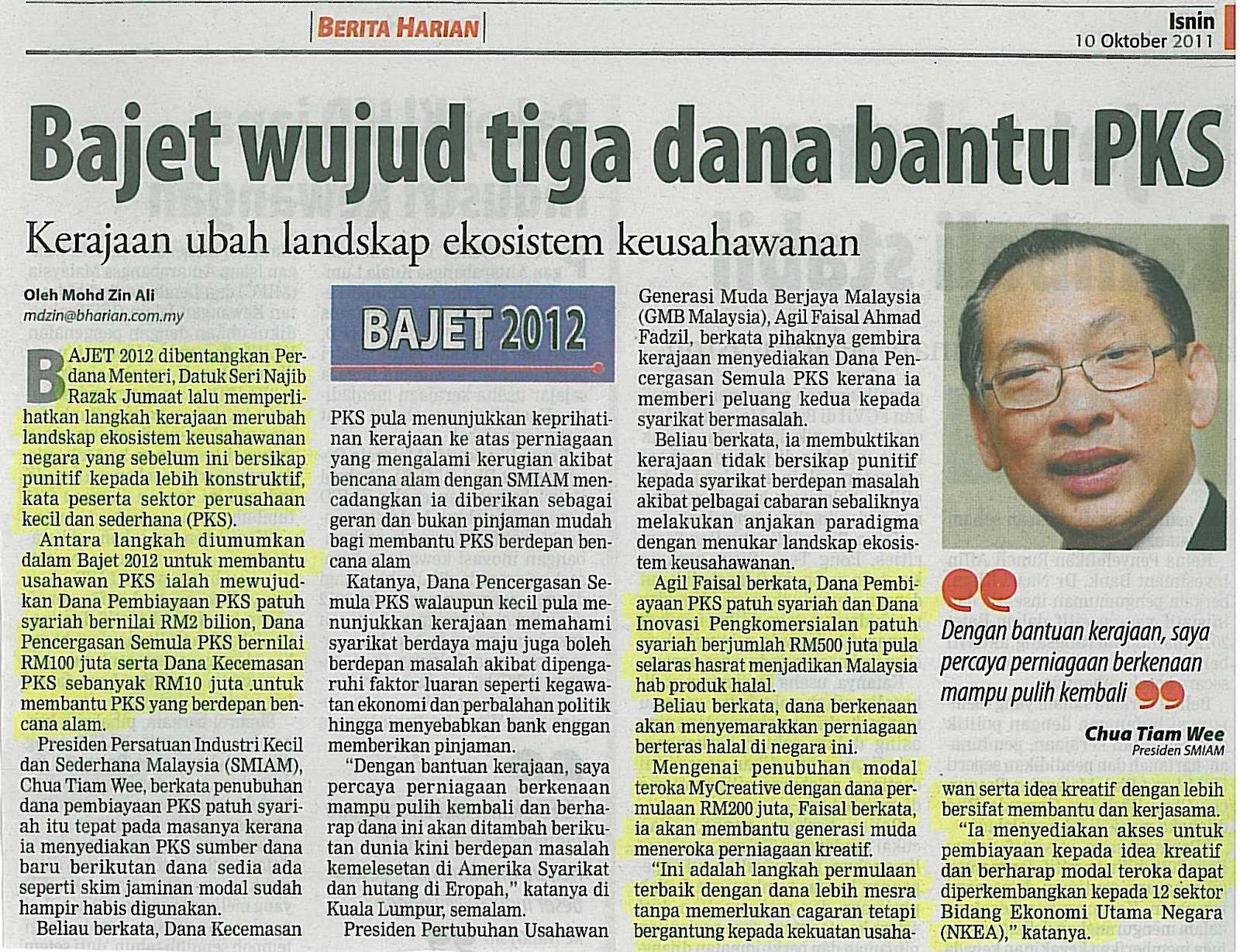

Today's Pick (10/10/11/183/623) Perks for SMEs will make Malaysia an Islamic financial hub
Perks for SMEs will make Malaysia an Islamic financial hub
THE proposed initiatives for small and medium-sized enterprises (SMEs) under Budget 2012 will not only strengthen the SMEs as growth drivers but promote the country's aspiration to become an Islamic financial hub, according to industry players.
Two of the four new funds were syariah-compliant the RM2bil SME Financing Fund and the RM500mil Commercialisation Innovation Fund. The other two were the RM100mil SME Revitalisation Fund and the RM10mil SME Emergency Fund.
The SME Financing Fund was to strengthen SMEs' contribution to economic growth while the SME Revitalisation Fund was for entrepreneurs to revive their businesses.
The SME Emergency Fund would provide assistance to SMEs affected by natural disasters and the Commercialisation Innovation Fund are for SMEs to commercialise research products.
Credit Guarantee Corporation Malaysia Bhd (CGC) managing director Datuk Wan Azhar Wan Ahmad told StarBizWeek that the syariah-based funds were good as they promoted the aspiration of the Government to promote Islamic finance.
“There is no indication which sector of the industry the RM2bil fund is targeting., This fund may attract the SMEs that already have facilities with conventional banks as they may switch to this due to its low cost of financing.
“New SMEs are more concern about access rather than cost. However, these schemes does not address the issue of credit risks as opposed to the schemes introduced in the last budget,'' he added.
The SME Revitalisation Fund, which offers soft loans of up to a maximum of RM1mil for entrepreneurs, is a preventive fund to help SMEs brace for any recession.
This fund was different from the previous SME rehabilitation schemes which only came onboard after a recession, he said, adding that the drawback was that the fund was small as in a recession, most of SMEs would apply for a maximum loan.
Meanwhile, SMI Association of Malaysia national president Chua Tiam Wee said the setting up of RM2bil syariah-compliant fund was timely as some of the popular SME funds by the government including the Working Capital Guarantee Scheme were almost used up.
He added the SME Revitalizing Fund, although relatively small in size, was good as it showed the Government understood that viable businesses could also be affected by external factors beyond their control such as an economic slowdown.
Wan Azhar: ‘New SMEs are more concern about access rather than cost.’
Chua hoped that the Government would top up the fund as it was expected to be sought after in view of the possible double dip recession in the United States and economic slowdown in Europe.
As the quantum of the National Emergency Fund was quite small, the association proposed that it should be disbursed entirely as grants instead of soft loans to help the affected SMEs.
Chua also welcome tax incentives for fees paid for franchise schemes as franchises were a proven successful business model and good for new SMEs.
On the Commercialisation Innovation Fund, he said it would help SMEs to commercialise new innovative products and services from R&D initiatives as commercial banks may not be keen to finance these ventures due to the risks involved
Source : The Star
Date : 8 October 2011
Today's Pick (10/10/11/183/623)


Afternoon Highlight (28/09/11/169/478) Only deserving bumiputras should be promoted, says PM
Only deserving bumiputras should be promoted, says PM
KUALA LUMPUR: Any affirmative action to help bumiputras should be based on meritocracy to ensure only the deserving ones are promoted, said the Prime Minister.
Datuk Seri Najib Tun Razak, citing a criticism he had often made that the right people had not been promoted in the past, added that bumiputras should no longer depend on quotas to advance.
“If you give them quota, what will happen is that they will rest on their laurels and eventually they will not gain expertise and management skills,” he said at a dialogue session at the closing of Khazanah Megatrends Forum 2011.
Najib said promoting the right people to help them succeed was important. “If the right bumiputras are promoted, they will succeed and the non-bumiputras will not begrudge them,” he added.
However, he stressed that the assistance given to the bumiputras should allow them to grow from small or medium entrepreneurs to something bigger.
Najib also said that giving bumiputras the 30% quota (of shares) would not be effective as they would only end up with a small percentage.
This, he said, was because they sold down their stakes to repay the bank loans they had taken to buy the shares in the first place.
“Now we have to find a good bumiputra, tested bumiputra and dedicated bumiputra who can succeed.
“We can support them and make them more competitive. These are some of the initiatives that we have identified,” he added.
The Prime Minister also said new legislation as well as amendments and the repeal of several existing Acts would be made in the coming parliamentary session.
He said the Government would decide today on the timetable for the new legislation and the amendments or repeal of Acts.
“The recent announcement I made was to reflect the Government's commitment to ensure greater civil liberties in the country. We want Malaysia to be a modern, functioning democracy,” he said.
He added that the Government would also look at best practices already in place in the region or further afield.
On Sept 15, Najib announced the abolition of the Internal Security Act and the Banishment Act. Two new Acts would be in place to cover terrorism and subversion


Today's Pick (26/09/11/173/613) Malaysia August inflation level eases to 3.3pc
Malaysia August inflation level eases to 3.3pc
KUALA LUMPUR: The inflation level, as measured by the Consumer Price Index (CPI), eased to 3.3 per cent in August from 3.4 per cent in July.
According to the Statistics Department, the index for food and non-alcoholic beverages and non-food for the month of August 2011 showed increases of 4.6 per cent and 2.7 per cent, respectively, as compared to the same month in 2010.
The CPI rose by 3.1 per cent for the first eight months of the year to 102.8 compared with 99.7 in the same period. Compared to July, it rose by 0.2 per cent.
Commenting on the data, Bank of America Merrill Lynch economist Dr Chua Hak Bin said food prices have been kept in check by price controls.Food accounts for a 28.9 per cent weight in the CPI basket.
During the recent Hari Raya Puasa festive season, the government put 20 food items under price control - including chicken, eggs, beef, coconut, red chillis and garlic.Chua also expects the government to introduce measures in the upcoming 2012 Budget to help mitigate higher costs coming from food supply, housing and public transport.He also expects Bank Negara Malaysia (BNM) to hold the Overnight Policy Rate at 3 per cent for the November monetary policy meeting, given "increased downside risks to the domestic economy".Industrial production contracted 0.6 per cent in July, while inflation pressures are retreating.
"We are not ruling out a surprise 25 basis points policy rate cut at the November meeting if the US and or the European Union slips into recession, or Europe's sovereign debt crisis worsens."
He said the bank's US team said there is a 40 per cent chance of a US recession in the next 12 months.
"We find that Malaysia's inflation falls in past recession episodes to varying degrees, falling by 0.6 per cent point from peak-to-trough for the milder 2001 technical recession to 1.5 per cent point for 2008 global financial crisis (and to 4.5 per cent for Asian financial crisis.
"Credit Suisse also expects BNM to be in no hurry to adjust the policy rate in a sluggish global growth scenario.
Economist Wu Kun Lung said the ringgit has also depreciated by over 5 per cent against the US dollar since early September.
"Although most of this reflected a flight to safety to the US dollar, even on a trade-weighted basis, we estimate that the ringgit depreciated by about 2.8 per cent in the past three weeks.
"Wu said it remains to be seen whether the currency will continue to depreciate."History suggests that it takes much bigger forex moves than we have seen so far to have a meaningful impact on Malaysian inflation," he said when commenting on the ringgit's impact on inflation levels.
Source : New Straits Times
Date : 22 September 2011
Today's Pick (26/09/173/613)


Today's Pick (21/09/11/170/610)Malaysia franchises abroad to grow 10pc
Malaysia franchises abroad to grow 10pc
The Malaysian Franchise Association (MFA) expects the number of local franchise companies establishing their business overseas to grow 10 per cent annually.
A main committee member of the MFA, Abdul Rahman Mohamed said 10 per cent was the minimum target, with 39 companies currently operating in 51 countries.
"The food and beverages sector and education business will have the most potential in expanding its business overseas," he said after a media briefing on the upcoming Malaysian Franchise Awards 2011 today.
To date, businesses such as Nelson Franchise (M) Sdn Bhd and Daily Fresh Food Sdn Bhd have expanded to 17 nations.
On the other hand, Indonesia and China host the most Malaysian franchise companies at 18 and 14, respectively.
"Malaysian companies must also must be praised for their courage in entering tough markets such as Yemen, Nigeria and Azerbaijan," Abdul Rahman said. -- Bernama
Source : New Straits Times
Date : 20 September 2011
Today's Pick (21/09/11/170/610)
afternoon highlight (20/09/11/163/471) Car industry value estimate trimmed
Car industry value estimate trimmed
HwangDBS Vickers has trimmed Malaysia's total industry value (TIV) estimate this year by two per cent to 599,000 units from an earlier forecast of 611,000 units to reflect a longer-than-expected recovery post-Japan disasters.
It said the lower forecast, also implied a one per cent drop year-on-year, was mainly derailed by components shortages after the Japan earthquake and tsunami in March and amendments to the Hire Purchase Act on June 15, which slowed down the car registration process.
"As a result, TIV slipped 19.5 per cent month-on-month in April; 9.6 per cent in May; and 9.2 per cent in June," it said in a research note today.
The research house said full recovery in sales was expected to take a longer time amid lingering cautious consumer sentiment.
However, HwangDBS Vickers expects the TIV for next year to grow by 3.8 per cent year-on-year to 622,000 on the back of 5.2 per cent GDP growth for the year. Accordingly, it has cut the sector's net profit by 3.4 per cent this year and 2.9 per cent next year after factoring in slightly higher promotional expenses such as rebates and free gifts.
Top pick for the sector was MBM Resources which is rated with "buy" call but revised the target price to RM3.02 from RM3.90 while UMW Holdings was downgraded to "hold" from "buy" with a lower target price of RM6.43 from RM7.30. -- Bernama
Source : New Straits Times
Date : 20 September 2011
afternoon highlight (20/09/11/163/471)
Today's Pick (20/09/11/169/609) TERAJU sasar 100 firma Bumiputera kelas dunia
TERAJU sasar 100 firma Bumiputera kelas dunia
Kumpulan pertama program TERAS diumum Oktober SEJUMLAH 100 syarikat disasar menjadi kumpulan pertama daripada 1,100 syarikat Bumiputera yang ditetapkan untuk dibangunkan sebagai syarikat besar berkelas dunia di bawah Unit Peneraju Agenda Bumiputera (TERAJU) akan diumumkan dalam mesyuarat Majlis Tindakan Agenda Bumiputera (MTAB) bulan depan.
Sehingga kini, sejumlah 80 syarikat Bumiputera dikenal pasti melepasi saringan awal untuk dimasukkan ke dalam Program Perusahaan Kecil dan Sederhana Bumiputera Berprestasi Tinggi (TERAS).
Ketua Eksekutif TERAJU, Husni Salleh, berkata syarikat terbabit akan menjadi kumpulan pertama yang akan dibentuk menjadi syarikat berdaya saing dalam tempoh lima tahun sejajar Agenda Pembangunan Bumiputera. Beliau berkata, sebanyak 200 lagi syarikat pula sedang berada dalam senarai menunggu dan kini dalam proses pemilihan untuk menyertai program TERAS.
“Kumpulan pertama syarikat Bumiputera yang menyertai program berkenaan akan diumumkan akhir bulan depan,” katanya dalam satu temu bual dengan kumpulan akhbar The New Straits Press di Petaling Jaya, baru-baru ini. Program TERAS yang dilancarkan Julai lalu bermatlamat membangunkan generasi baru usahawan Bumiputera bertaraf global dalam 12 Bidang Ekonomi Utama Negara (NKEA).
Penyertaan syarikat Bumiputera dalam program itu disasar dapat meningkatkan kapasiti, mempercepatkan pertumbuhan dan bersaing dalam pasaran terbuka tanpa bergantung kepada kontrak kerajaan.
Husni berkata, syarikat Bumiputera yang menyertai program berkenaan akan dibahagikan kepada peringkat tertentu bergantung kepada saiz masing-masing sebelum keupayaan mereka dinilai untuk melaksanakan beberapa projek permulaan (EPP) di bawah Program Transformasi Ekonomi.
“Kita akan meminta bantuan agensi berkaitan untuk membimbing syarikat berkenaan menggabungkan beberapa projek kecil sehingga akhirnya dapat dijadikan satu projek besar. “Syarikat yang dipilih itu terdiri dalam pelbagai sektor, namun keutamaan diberikan kepada syarikat yang terbabit dalam 12 sektor NKEA,” katanya.
Beliau menjelaskan, syarikat dipilih itu perlu melepasi kriteria jelas, termasuk memiliki penarafan minimum tiga bintang SCORE oleh SME Corp, mempunyai penarafan kredit baik yang dinilai Biro Kredit Malaysia dan mesti menunjukkan potensi cemerlang untuk menjadi perniagaan yang menguntungkan serta boleh berkembang. “Ini bermakna syarikat terbabit mesti meningkatkan kapasiti dan mempercepatkan pertumbuhan mereka supaya boleh bersaing dalam ekonomi arus perdana,” katanya.
Source: Berita Harian
Date : 19 September 2011
Today's Pick (20/09/11/169/609)


Today's Pick (15/09/11/167/607)Education and Health: two key areas to be strengthened, says Muhyiddin
Education and Health: two key areas to be strengthened, says Muhyiddin
KUALA LUMPUR: Education and health are two key areas to be strengthened towards making Malaysia a fully developed country by the year 2020, said Deputy Prime Minister Tan Sri Muhyiddin Yassin.
He said the government always encouraged any form of cooperation between private and public sectors in developing the two areas.
In terms of education, Muhyiddin, who is also the Education Minister, said Malaysia now attracted students from China, Africa and West Asia because of the low cost in pursuing higher studies in this country as compared to studying in Europe or countries such as the United Kingdom and Australia.
He said this at a dialogue session with the Chairman and Chief Executive Officer (CEO) of Forbes, Steve Forbes at the Forbes Global CEO Conference 2011 here today.
Furthermore, Muhyiddin said the Malaysian government now was also active in promoting medical tourism in which people could get quality medical treatment at various hospitals and specialist centres throughout the country. “Malaysia is now the first choice destination for people from Indonesia in the aspect of medical tourism," he said.
On terrorism, he said Malaysia focused on engaging closely with other parties, internally and externally in combating terrorism, adding that the government was very commited to fighting terrorism in any form.
"We have cooperated with many countries such as the United States and Australia where transboundary issues including human trafficking is being dealt with," he said.
The three-day Forbes Global CEO Conference 2011 which ended here today brought together CEOs and leaders of some of the world's most important companies to share their winning strategies. -- BERNAMA
Source : New Straits Times
Date : 14 September 2011
Today's Pick (15/09/11/167/607)
afternoon highlight (14/09/11/160/468)Entrepreneurs should be ready for real competition, say panelists
Entrepreneurs should be ready for real competition, say panelists
KUALA LUMPUR: Entrepreneurs should compete in real competition rather than rely on "powers" to grow their businesses at a faster pace.
This was the consensus by panelists at the second day of the 11th Forbes Global CEO Conference in a session entitled "Blazing your own trail".
The session aims to inspire entrepreneurs who start new businesses, open markets, scale up, generate profits and create value.
One of the panelists, Chairul Tanjung, chairman of Para Group, said many companies were not ready for real competition because they competed via connection and protection.
Malvinder Mohan Singh, group chairman of Fortis Healthcare, said an entrepreneur must be able to differentiate between passion and obsession."It is important to be objective and able to avoid emotion and ego in the middle of business decision-making because it will end up with higher price for the assets if we are too obsessed with details," he said.
Malvinder said the difference between an entrepreneur and a businessman was that business leaders conformed to governance standard and rules, while gut feelings had always been a part of an entrepreneur's decision-making process.
On whether a Master of Business Administration was valuable in the real world, he said it was only a tool and analysis capability but it could not provide the learning experience.
Mario Moretti Polegato, founder/chairman of the fast-growing Italian shoe company, Geox, said a successful entrepreneur combined technology and market needs.He said entrepreneurs should opt for innovation, including creating and modifying ideas, then testing them before venturing into business.
"As most entrepreneurs do not have capital to test their ideas, they should collaborate with universities to achieve their goals," he said.
Sam Goi Seng Hui, executive chairman of Tee Yih Jia Group, a leading manufacturer of spring roll pastry, said an entrepreneur should not fear for being a small player.
Goi said the group's first market was Australia but it did not fear the big boys."The group has now expanded to other markets including in the UK, Japan and New Zealand," he said. - Bernama
Source : New Straits Times
Date : 14 September 2011
afternoon highlight (14/09/11/160/468)

afternoon highlight (13/09/11/159/467) GCH Retail to invest RM60mil in Sarawak ops
GCH Retail to invest RM60mil in Sarawak ops
SIBU: GCH Retail (M) Sdn Bhd will invest close to RM60mil to expand its operations in Sarawak.
Its chied operating officer Tom Herriott said the retail chain planned to open two more hypermarkets in Sarawak, besides the Sibu and Tabuan Jaya branches. Tabuan Jaya is a township in Kuching.
“The investment reflects the group’s confidence in the economic and business development of Sarawak. The Sibu investment is close to RM12mil,” he said at the opening of the Sibu Giant hypermarket by Chief Minister Tan Sri Abdul Taib Mahmud yesterday.
He said Giant had 121 stores and close to 14,000 employees. “We believe we must set the benchmark for the industry, both in generating economic spinoffs for the country and in delivering on our commitment to offer consumers low price, great value and variety everyday,” he said.
Herriott said that in line with Giant’s policy of giving priority to local supplies, most of the fresh food items would be sourced from the state to promote its agro-based and food-related industries. “These will also be sold at our stores nationwide,” he said.
He said the Sibu hypermarket had created 250 jobs and would increase opportunities for local traders and entrepreneurs who could take up tenency within the complex.
Source : The Star
Date : 13 September 2011
afternoon highlight (13/09/11/159/467)
Today's Pick (13/09/11/165/605) Industri halal sasar 2 angka
Industri halal sasar 2 angka
MALAYSIA menyasar untuk mencatat pertumbuhan dua angka dalam jumlah eksport industri makanan dan minuman halal yang diproses bermula tahun ini dan seterusnya, yang mana antara lain disumbangkan aktiviti seperti penganjuran Halal Fiesta Malaysia (HALFEST).
Menteri Perdagangan Antarabangsa dan Industri (MITI), Datuk Seri Mustapa Mohamed, berkata pada tahun lalu jumlah eksport makanan dan minuman halal yang diproses adalah RM8.2 bilion.
Katanya, potensi sektor berkenaan sewajarnya dieksploitasi sebaik mungkin oleh usahawan sedia ada agar permintaan industri halal bergerak dengan lebih aktif untuk menampung permintaan yang semakin meningkat.
Beliau berkata, permintaan daripada destinasi eksport utama seperti Amerika Syarikat, China, Pakistan, Jepun dan Singapura sentiasa meningkat berikutan rakyat mereka mula menyedari kualiti produk dari sektor itu.
Sasaran dua angka untuk jumlah eksport industri makanan dan minuman halal yang diproses ini boleh ditingkat dengan mudah jika kita memperbaiki strategi di pasaran sedia ada, termasuk menerusi penganjuran HALFEST 2011 bulan depan, Pameran Halal Antarabangsa Malaysia dan pelbagai inisiatif lain.
Sebenarnya RM8.2 bilion masih kecil jika dibandingkan potensi yang ada dan ia masih perlu ditambah supaya Malaysia diiktiraf sebagai peserta yang signifikan dalam pasaran halal global, katanya selepas melancarkan HALFEST di Kuala Lumpur, semalam. Mustapa menjelaskan, tanggapan negatif bahawa Malaysia tidak akan mampu bersaing secara kompetitif di pentas antarabangsa perlu diubah kerana hakikatnya, negara mampu memberikan persembahan lebih baik berbanding Brazil, Thailand dan Australia yang terlebih dulu menempa nama. Terdahulu dalam ucapannya, Mustapa berkata, HALFEST dan ekspo lain adalah batu loncatan yang membantu syarikat tempatan mengukuhkan jenama produk serta menambah baik perkhidmatan yang diberikan agar menepati standard serta piawaian antarabangsa.
Antara lain, ekspo ini juga akan menarik minat lebih banyak usahawan tempatan untuk bersaing dengan lebih agresif bagi menembusi pasaran global, selain menjadi perantara kepada syarikat antarabangsa untuk menilai kemampuan dan hasil pengeluaran syarikat halal tempatan, katanya.
Pasaran halal global jelas beliau lagi, menjanjikan potensi sangat besar kerana mencatatkan lebih AS$2.3 trilion setahun.
Source : Berita Harian
Date : 10 September 2011
Today's Pick (13/09/11/165/605)

Today's Pick (12/09/11/164/604) Prepaid mobile users to pay 6pc service tax
Prepaid mobile users to pay 6pc service tax
KUALA LUMPUR: Come Sept 15, prepaid mobile users will need to pay a six per cent service tax whenever they buy a starter pack or reloads.
This means, a customer will need to pay RM10.60 for a RM10 prepaid reload.
"Service tax is a consumption tax and chargeable to the customer, as provided for in the service tax laws.
"The Service Tax Act 1975 requires telecommunication companies to levy service tax at the prevailing rate on telecommunication services, including mobile prepaid services.
"This is similar to the service tax levied on food and beverage purchases from restaurants and hotels," said mobile service providers in a joint statement yesterday.
Since the launch of mobile prepaid services in 1998, mobile operators have been absorbing the service tax.
According to mobile operators, the move was to ensure mobile prepaid services remained competitive compared with postpaid. "With prepaid rates progressively reduced over the years, it is currently offered at very competitive rates," they said.
Telecommunications analysts view the news as "generally positive" for mobile operators, with DiGi.Com Bhd seen as the biggest beneficiary and Maxis Bhd benefiting the least.
As at June 30 this year, 83 per cent of DiGi's customer base comprised prepaid users. In contrast, about 75 per cent of Maxis' customers were prepaid users.
Today, prepaid users are spending about RM36 to RM51 a month. Analysts believe the implementation of the service tax is unlikely to reduce prepaid users spending significantly.
Source : New Straits Times
Date : 9 September 2011
Today's Pick (12/09/11/164/604)
afternoon highlight (09/09/11/157/465) Bank Negara’s overnight policy rate stays at 3%
Bank Negara’s overnight policy rate stays at 3%
PETALING JAYA: The overnight policy rate (OPR) remained unchanged at 3% after Bank Negara's monetary policy committee meeting yesterday.
In a statement, the central bank said recent indicators in the domestic economy pointed to slower growth in external demand following the weaker global economic environment.
It noted that domestic growth prospects, however, continued to remain positive, underpinned by the expansion in private consumption and private investment.
“Moving forward, the more challenging external environment has, however, increased the downside risks to the domestic economy.”
The central bank also said that going forward, inflation is expected to remain relatively stable for the rest of the year.
It added: “While inflation remains a concern, the increased uncertainties on the global and domestic economic growth prospects and their potential consequences could have a moderating impact on inflation.”
Source : The Star
Date : 9 September 2011
afternoon highlight (09/09/11/157/465)
Today's Pick (09/09/11/163/603) PM announces 8 new investment projects worth RM1.4b
PM announces 8 new investment projects worth RM1.4b
KUALA LUMPUR: Prime Minister Datuk Seri Najib Tun Razak announced today eight new investment projects worth RM1.4 billion in various sectors such as agriculture, education, aerospace, wholesale, retail and manufacturing.
He said Kuala Lumpur Kepong Bhd will invest RM706 million in an effort to develop the downstream sector of the palm oil industry.In an initiative to develop and position Malaysia as a hub for high value engineering services, Stand Aerospace Malaysia Sdn Bhd, will invest RM177 million.
In healthcare, Vasseti Datatech Bhd will invest RM400 million to deploy 1,410 sets of 42" television sets at 168 locations nationwide, including hospitals, 1Malaysia clinics and Ministry of Health sites.
For agriculture, Najib said Hannan Corporation Sdn Bhd will invest RM72.6 million in two aquaculture complexes that can produce 14,000 tonnes of white shrimp per annum.On high-value herbal products, Nova Laboratories Sdn Bhd will invest RM16.29 million in research and development as well as pre-clinical and clinical trials to develop three high value herbal products and its commercialisation.
Meanwhile, Doorstep Retail Sdn Bhd will invest RM35 million by 2020 to provide a platform of convenience for small medium enterprises (SMEs) in terms of technical support and facilities.Complementing this, Koperasi Jiwa Malaysia Bhd will lead an initiative to provide a virtual mall platform for SMEs to enter the online sphere, with an investment of RM15 million.
The eighth investment will see DSEM Holdings Sdn Bhd evolve from contract manufacturing into a company that produces, distributes and markets its own brand of LED products.
Turning to human capital, the Prime Minister said MSC Malaysia's MyProCert is a programme to upskill Malaysians towards international certification standards, alongside the National Talent Enhancement Programme (NTEP).
He said the NTEP is open to engineering graduates with between one or two years of working experience and those who wish to upskill/re-skill to enter into the electrical and electronics and green technology sectors.
Five agencies and companies would spearhead this initiative, namely Akademi Teknologi Hijau Sdn Bhd, the East Coast Economic Region Development Council (ECERDC), the Iskandar Regional Development Authority (IRDA), Northern Corridor Implementation Authority (NCIA) and the Selangor Human Resources Development Centre (SHRDC).
Meanwhile, TERAS which aims to increase Bumiputera SMEs, has identified to date 100 Bumiputera SMEs and 1,000 small/micro companies as a starting point.Najib said the participation of Bumiputera SMEs was encouraging and urged more to come on board, going forward.
Source : New Straits Times
Date : 9 September 2011
Today's Pick (09/09/11/163/603)


afternoon highlight (07/09/11/155/463) MARA wujud pakatan sedia dana
MARA wujud pakatan sedia dana
Kerjasama dengan bank tempatan mampu tingkat jumlah pembiayaan BAGI menyediakan dana pembiayaan lebih besar kepada usahawan Bumiputera, Majlis Amanah Rakyat (MARA) berhasrat mewujudkan pakatan dengan beberapa lagi institusi perbankan tempatan dalam tempoh terdekat ini.
Timbalan Ketua Pengarah MARA, Mohd Rosdi Ismail berkata, pakatan yang bakal diwujudkan itu akan membolehkan agensi itu meningkatkan jumlah penyediaan kemudahan pembiayaan kepada usahawan Bumiputera berbanding hanya RM500,000 sekarang.
“Ketika ini, menerusi Skim Jaminan Usahawan Bumiputera Mara (SJUM), MARA sudah pun menjalinkan pakatan dengan Bank Muamalat Malaysia Bhd yang bertindak sebagai penyedia pinjaman, sementara MARA pula bertindak sebagai penjamin.
“Sejak diperkenalkan tahun lalu, skim itu telah mendapat sambutan hangat sekali sehingga memerlukan MARA memperbesarkan skop penyediaan pembiayaannya.
“Justeru, bersandarkan kepada situasi semasa, MARA berhasrat memperluaskan lagi skop pakatan yang diwujudkan bersama dengan Bank Muamalat dan beberapa lagi institusi perbankan tempatan yang lain bagi membantu meningkatkan sumber pembiayaan kepada usahawan Bumiputera,” katanya selepas mewakili MARA memeterai perjanjian persetujuan dengan Shapers Malaysia Sdn Bhd bagi penganjuran program Halal Fiesta Malaysia yang pertama (Halfest 2011), di Kuala Lumpur semalam.
Majlis itu disaksikan Menteri Kewangan Kedua, Datuk Seri Ahmad Husni Hanadzlah, dan Ketua Eksekutif Halal Industry Development Corporation (HDC), Datuk Seri Jamil Bidin.
Bagi menjayakan hasrat pakatan bersama institusi perbankan berkenaan, Mohd Rosdi berkata, MARA buat permulaan ini, akan mengadakan rundingan dengan CIMB Islamic Bank Bhd tidak lama lagi kerana bank terbabit tertarik dengan program yang dianjurkan MARA, khususnya dalam penyediaan sumber pembiayaan untuk mewujudkan lebih ramai lagi usahawan global dari kalangan Bumiputera.
“Mereka (CIMB Islamic Bank) menawarkan diri untuk menjalinkan pakatan dengan MARA dan kami akan mengadakan perbincangan lanjut mengenainya tidak lama lagi,” katanya sambil menambah agensi berkenaan juga terbuka untuk mengadakan pakatan dengan institusi perbankan lain yang berminat.
Source : Berita Harian
Date : 6 September 2011
afternoon highlight (07/09/11/155/463)

Today's Pick (07/09/11/161/601)Bumis told to enter manufacturing, IBS
Bumis told to enter manufacturing, IBS
KUALA LUMPUR: Bumiputra companies should be more involved in manufacturing based and industrialised building system (IBS) sector, UDA Holdings Bhd's chairman Datuk Nur Jazlan Mohamed said.
Currently, there is only 10 per cent Bumiputera participation in procurement and supply chain within the construction industry.
Bumiputera participation is most highest in maintenance, planning and design, he said.Jazlan said greater involvement in manufacturing based and IBS will help sustain Bumiputera participation in the industry.
"Having more locally produced IBS will not only make the industry more cost effective but through this effort, Bumiputera players can be more innovative and grow globally," he told Business Times.
Jazlan said the government needs to restructure the outdated Bumiputera agenda and ensure that a reformed policy will not just benefit the one person who gets the contract.
"Times have changed ... creation of wealth must be shared," he added.
UDA has been criticised for neglecting its social responsibility in supporting Bumiputera initiatives against profit generation and corporate objectives.
Jazlan said the government should not give in to the pressure groups and should realise that the cost of Bumiputera agenda is not sustainable in the long run.
"UDA is one example. It was not profit-driven from the start. When it was established, the company's main aim was to develop and build, and was given an annual grant of multi-million ringgit," he said.
He said the completed projects were given to Bumiputeras who requested for a further discount in rental cost. The assets were then left rundown as they got too expensive to be managed by UDA.
While its neighbours like Starhill, Lot 10 and Fahrenheit 88 have undergone several refurbishment exercises over the years, BB Plaza, which is owned by UDA has not been refurbished or renovated since 1992 due to lack of cash.
UDA had recently spent RM63 million to renovate the Puduraya bus terminal and is now set to lose RM1 million a year because tenants refuse to pay higher rent.
"The Bumiputera agenda desperately need to be restructured. It is not impossible. Government must explain properly on the losing cost to sustain this agenda," Jazlan said.
Source : New Straits Times
Date : 6 September 2011
Today's Pick (07/09/11/161/601)
Afternoon Highlight (05/09/11/153/461) Adidas to step up presence in Malaysia
Adidas to step up presence in Malaysia
PETALING JAYA: Adidas (Malaysia) Sdn Bhd, part of Germany-based Adidas Group, may open more stores in Malaysia and increase its product line to improve its share in the sporting goods market.
Its country manager, Ng Chee Loon, said in an interview with Business Times that Adidas is evaluating retail opportunities as consumers become more brand loyalists.
Ng said while the company will be selective in opening new stores, it will invest to make the existing outlets more efficient and display new products.
Adidas Group is the parent of adidas, Reebok and TaylorMade Golf. It is the world's second largest maker of athletic footwear, apparel and equipment by sales after Nike.
In Malaysia, the dominant leaders in the sporting goods industry are Nike and Reebok.
Adidas Malaysia was incorporated in 1995. The popular brands under the adidas label are Y-3, SLVR, Porsche Design Sport and Neo.
The company currently operates 40 standalone outlets and has presence in more than 350 stores that carry multi-brand names.
Ng said the jump in world-class international sporting events being hosted here such as the visits of English Premier League clubs Liverpool and Chelsea and the F1 Malaysian Grand Prix has benefited the company.
"As a result, we see strong potential here for future growth as more people take up sports and a liking to the adidas brand. We will continue to participate in sports events and sponsorships," he said.
Ng said competition will become more intense as retailers across the board fight for consumers' money.
"Consumers will be picky on what they spend as prices of goods continue to rise. Retailers in all sectors will become my competitors as we fight for a portion of their spending money," he said.
To grow the company, Ng said, Adidas will strengthen its retail presence through owned stores, franchises and "Shop in Shop" with wholesale accounts.
"We will also invest in the quality of our people to improve productivity and provide better services."People are important in this business.
They are our key assets," Ng said.
Source : New Straits Times
Date : 5 September 2011
Afternoon Highlight (05/09/11/153/461)


Subscribe to:
Posts (Atom)